 703.707.9680




Quick Answer: What Should Broadband Providers Do First After a BEAD Award?
- Confirm funded locations exist, can be reached, and aren't already served.
- Map permits by project area and open talks with pole owners.
- Order permits and make-ready only for the routes you'll actually build.
- Check the complete design against every serviceable location before crews mobilize.
- From day one, record a status, a reason, and a reviewer for every location.
The Broadband Equity, Access, and Deployment (BEAD) program is moving from awards to construction. On May 14, 2026, a farm household near Ogallala, Nebraska, went live as one of the first BEAD-funded connections in the country. States are signing subgrant agreements, and the build clock is running.
If you’ve won an award, the work you do before design and construction decides how much rework, delay, and payment risk you carry. Here's what to confirm now, what to double-check once engineering wraps, and how to build the evidence file your state will eventually request.
Where Does the BEAD Program Stand in Late 2026?
Every Final Proposal now has federal approval, so the action has shifted to signed agreements and field work.
- The National Telecommunications and Information Administration (NTIA) approved its last Final Proposal on August 25, 2026, completing all 56.
- States like Michigan and Wisconsin give signed subgrantees four years from execution to substantially complete permitting, construction, and service. Terms vary, however, so check your state's agreement.
- Many states pay when you submit milestone evidence. Quarterly reports and audits run through closeout.
What Did RDOF Defaults Reveal About Broadband Data?
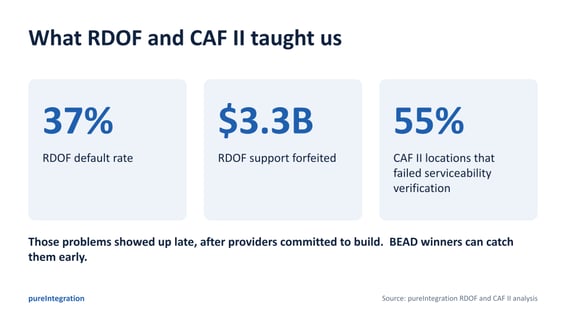
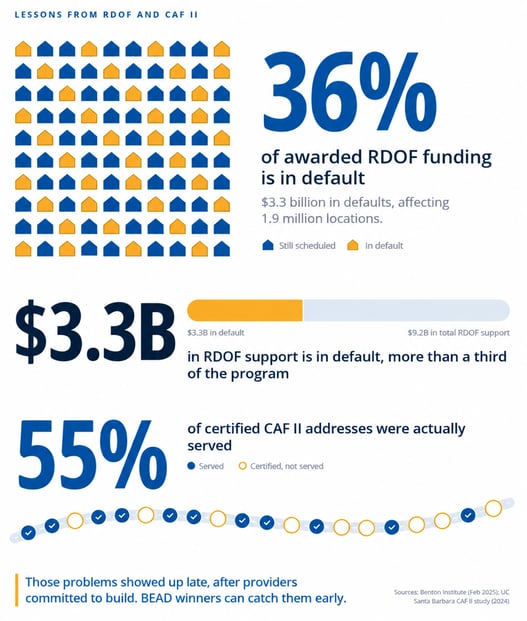
By early 2025, providers had defaulted on $3.3 billion in RDOF awards, approximately 36% of awarded funding, affecting 1.9 million locations. Awards in California, Massachusetts, and New Jersey defaulted at a rate of 89% to 100%. In Connect America Fund Phase II (CAF II), 55% of locations failed serviceability verification.
Those problems showed up late, after providers had already committed to building out their awarded areas. But BEAD winners can catch them early.
For the full story, read how bad broadband data derailed RDOF.
Why Finding Bad Locations Early Protects BEAD Awards
A bad location is defined as one that does not exist, that is already served, or that cannot be reached. Uncovering these issues early protects your budget, your schedule, and your funding.
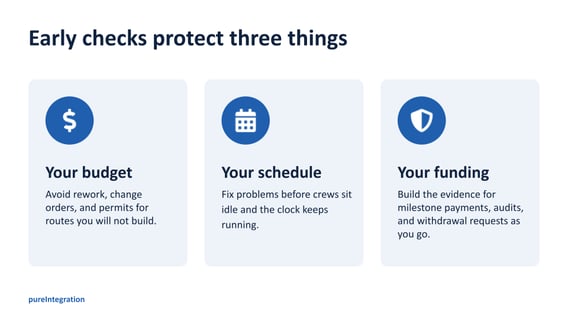 Protect your budget
Every bad location you catch before design saves money in four ways:
- Rework means paying twice for the same work. A redesign, a second walkout, a rebuilt segment, and a resubmitted permit all count.
- Change orders add cost to a fixed award.
- You skip permits, make-ready, and materials for routes you will not build.
- Crews make fewer return trips to remote sites.
Protect your schedule
Early fixes also keep your build calendar intact:
- The clock starts at signing. Late fixes use days you cannot get back.
- Early discoveries leave room to resolve problems before crews sit idle.
Protect your funding
Accurate location records protect every dollar of your award:
- Building evidence as the work happens keeps milestone payments on schedule.
- A slow payment ties up your cash and keeps your letter of credit or bond open longer.
- Some locations may qualify for withdrawal from your build list. Each request needs documented evidence, and early verification gives you time to gather it.
- When auditors ask, every location should have a status, a reason, and a reviewer.
- Default is the worst outcome. Providers that default forfeit support.
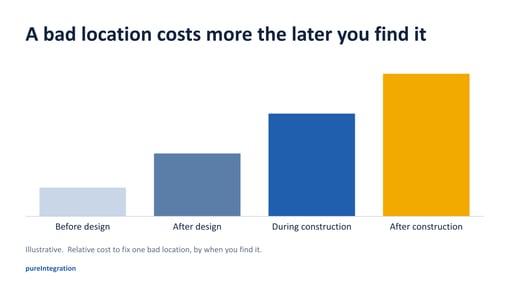
How Costs Change When Problems Surface Later
|
Issue
|
Found Before Design
|
Found After Construction Starts
|
|---|---|---|
|
Location doesn't exist
|
Flag it and start building withdrawal evidence
|
Design, permits, and make-ready already paid for
|
|
Location is already served
|
Raise it with your state before you design
|
Duplicate build and a reporting problem
|
|
Location can't be reached on the planned route
|
Re-route on paper
|
Redesign, new permits, and remobilized crews
|
|
Permit conflict on the route
|
Pick another route or file early
|
Crews wait while the permit clears
|
What Should BEAD Winners Confirm Before Design Begins?
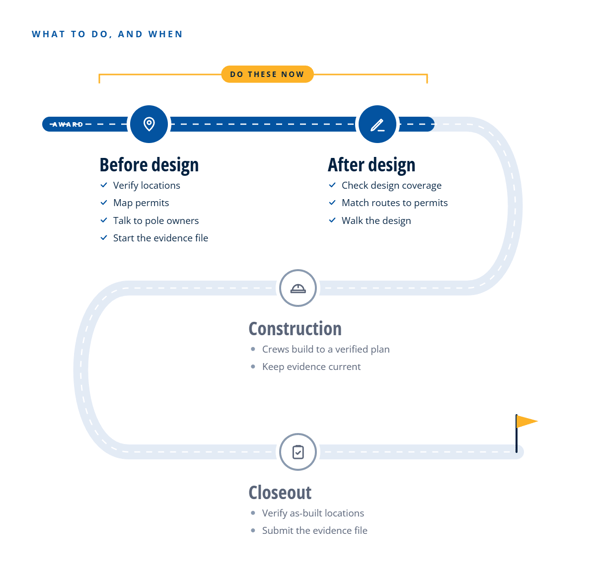
Work through these seven items before design starts:
- Confirm that every funded location exists, is not already served by another provider, and can be reached.
- Compare the FCC Fabric against current addresses and structures.
- Flag locations that may qualify for a withdrawal request. Each one needs evidence.
- Map permits by project area. The median BEAD project needs about 11 permits from eight authorities, per a New York Law School analysis. Local permits now delay projects more than federal review.
- Begin talking to pole owners. Attachment agreements take months, and make-ready disputes slow down builds.
- Order permits and make-ready only for routes you will build.
- Start your evidence file. Record a status, a reason, and a reviewer for every location.
Want engineers to map permits and review locations across your project areas? Explore BEAD grant program support.
What Steps Come Between Final Design and Construction?
These three steps catch design gaps before they turn into field costs:
- Check that the design reaches every serviceable location.
- Match routes to permit packages before crews mobilize.
- Walk the approved design before construction starts.
Design already underway? These checks still pay off. Run them before major construction dollars go out.
How Does pureIntegration Support BEAD Subgrantees?
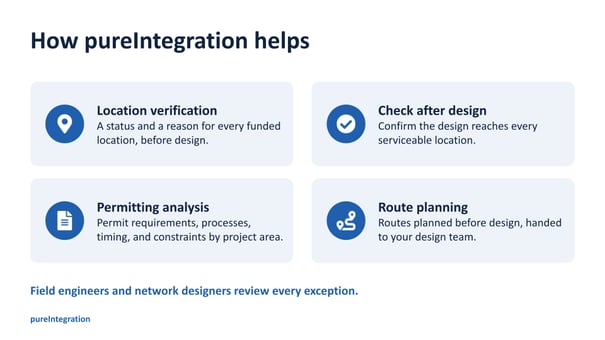
pureIntegration helps BEAD winners plan, verify, and close out their builds. VIA (Virtual Infrastructure Audit), pureIntegration's infrastructure intelligence platform, runs automated location checks, and field engineers and network designers review every exception.
You’ll receive an evidence record for every location.
- Location verification before design: a status and a reason for every funded location
- Post-design check: confirmation that the design reaches every serviceable location before construction
- Permitting analysis: permit requirements, processes, timing, and constraints, mapped by project area
- Route planning for new builds: routes planned before design and handed to your team
 After the build, pureIntegration verifies as-built locations and assembles the closeout file. See how to build audit-ready OSP data for closeout.
What Does a Sample BEAD Project Review Include?
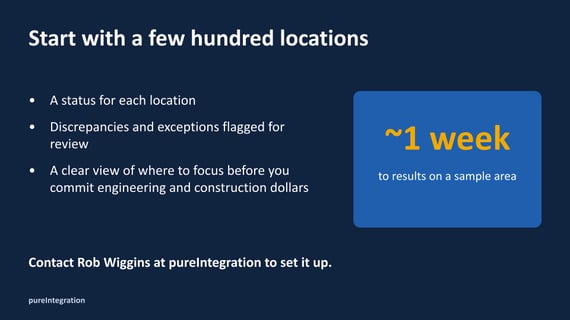
Start with a sample project area of a few hundred locations. In about a week, you get a status for each location and a list of discrepancies and exceptions that need review. You'll know where to focus before you commit engineering and construction dollars.
Know your infrastructure before the first crew rolls out. Contact Rob Wiggins at pureIntegration to set up a sample project review.